
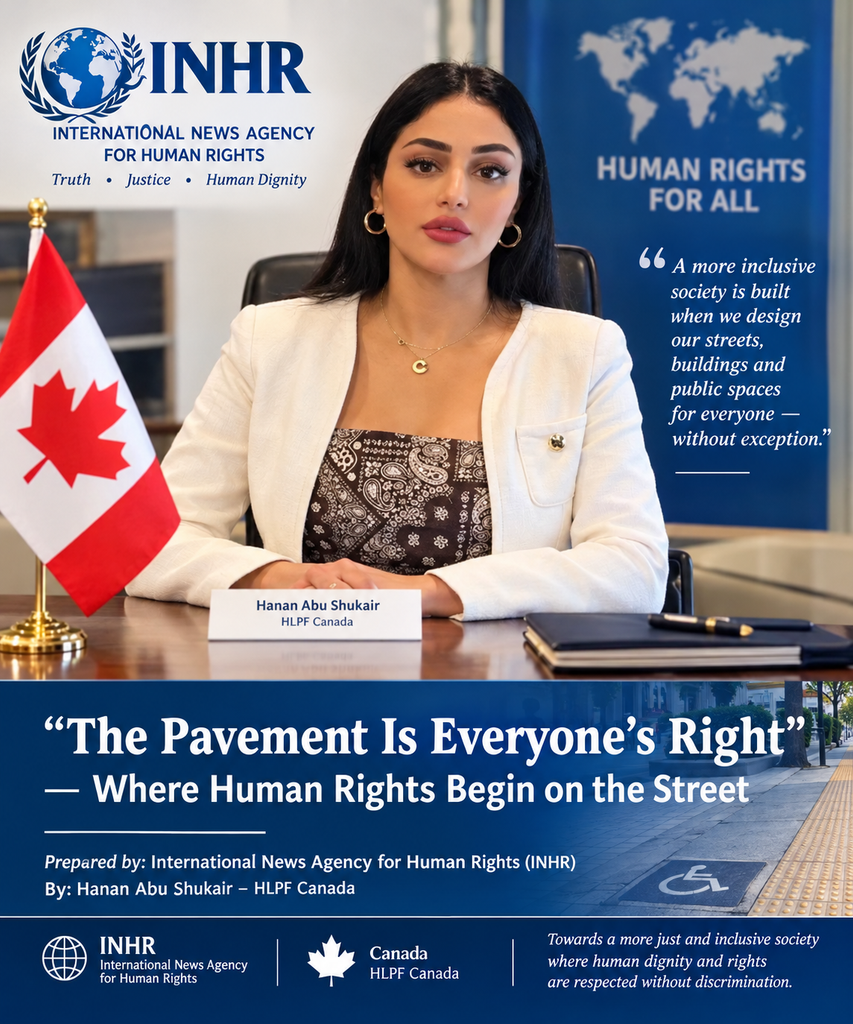
“The Pavement Is Everyone’s Right” — Where Human Rights Begin on the Street
Prepared by: International News Agency for Human Rights (INHR)
By: Hanan Abu Shukair – HLPF Canada
As part of its efforts to highlight the rights of persons with disabilities and older persons, as well as the importance of ensuring accessibility in public spaces, the International News Agency for Human Rights (INHR) presents this interview with Hanan Abu Shukair.
In this interview, she emphasises that respect for human rights should not begin with slogans, but with practical measures in everyday life that safeguard human dignity, independence, and the right to move freely and safely.
INHR: Why did you choose the title “The Pavement Is Everyone’s Right”?
Hanan Abu Shukair:
Because a pavement is not merely a space for walking; it is an essential part of every person’s right to move around and access public places and services.
When discussing the rights of persons with disabilities and older persons, we should not begin with slogans. We should begin with the streets people use every day.
In Beirut and many other parts of Lebanon, walking along a pavement can become a genuine challenge for a wheelchair user, an older person, a mother pushing a child’s pram, or anyone experiencing mobility difficulties.
INHR: What are the main obstacles these groups face in public spaces?
Hanan Abu Shukair:
There are obstacles that may seem minor to some people but create significant barriers for others. These include interrupted pavements, stairways without suitable ramps, vehicles parked on pedestrian pathways, and public buildings whose entrances lack appropriate accessibility facilities.
Such barriers can prevent people from reaching a government office, hospital, school, workplace, or even accessing essential services independently.
The problem is not limited to mobility difficulties. These barriers can also contribute to social isolation, continued dependence on others, and a sense of exclusion from public life.
INHR: Do you consider accessibility in public spaces an additional service or a fundamental right?
Hanan Abu Shukair:
Making public spaces accessible is not an additional service, nor is it a favour granted to persons with disabilities or older persons. It is an essential aspect of respecting human dignity and independence, as well as ensuring equal opportunities and non-discrimination.
We cannot claim to be building a society that respects human rights if some members of that society cannot enter a public building, use a pavement, or access an essential service because appropriate accessibility measures are absent.
A society that respects all its members is one that considers their needs from the outset when designing streets and buildings, rather than waiting for problems to arise before seeking temporary solutions.
INHR: What practical solutions could improve accessibility?
Hanan Abu Shukair:
The solution does not always require major infrastructure projects or substantial expenditure. Sometimes, practical and carefully planned measures can make a significant difference to people’s lives.
These measures include:
Installing suitable and safe ramps for wheelchair users.
Keeping pavements and pedestrian pathways clear of vehicles and other obstructions.
Equipping public institutions with accessible entrances.
Ensuring that lifts are operational, safe, and suitable for use by people with different mobility needs.
Taking the needs of older persons and persons with disabilities into account when planning roads and public facilities.
Strengthening municipal monitoring and enforcing regulations that protect pedestrians’ right to use pavements.
These steps are not merely urban improvements. They promote social participation, protect human dignity, and support independent living.
INHR: What message would you like to convey to municipalities and the relevant authorities?
Hanan Abu Shukair:
I call upon municipalities, public authorities, and relevant institutions to reassess the condition of pavements and public pathways and to make accessibility a priority in planning and implementation.
I also encourage the involvement of persons with disabilities and older persons in assessing accessibility needs and proposing appropriate solutions. Those who experience these barriers every day are often best placed to explain the challenges and identify what needs to change.
Public awareness must also be strengthened. People need to understand that parking vehicles on pavements or obstructing pedestrian pathways can deprive others of their right to move safely and independently.
INHR: How can we determine whether our streets truly respect everyone’s rights?
Hanan Abu Shukair:
We must ask ourselves some simple questions: Can a wheelchair user navigate our streets and reach their destination without requiring assistance at every step? Can an older person use the pavement and cross the road safely? Can a mother pushing a child’s pram move around without being forced to enter the road?
If the answer to these questions is no, then there is meaningful work that needs to be done.
Accessibility is not an issue that concerns only one particular group. It affects society as a whole, because people’s circumstances and needs can change with age or as a result of an accident, injury, or health-related circumstances.
Final Message
Hanan Abu Shukair:
I would like to emphasise that human rights are measured not only by laws, conventions, and official statements, but also by the extent to which people can exercise their rights in everyday life.
A pavement may appear to be an ordinary feature of the urban environment, but for someone else, it can represent the difference between independence and dependence, and between participation in society and social isolation.
We must therefore begin with the simplest places, the ones most closely connected to our daily lives, and work together to create streets, institutions, and public facilities that enable everyone to move with dignity and safety.
Human rights sometimes begin in the simplest of places… on the pavement.
International News Agency for Human Rights (INHR)
Towards a more just and inclusive society in which human dignity and rights are respected without discrimination.
Leave a Reply